Showing posts with label Tutorials. Show all posts

Thursday, June 28, 2012

Artisan Bread

Artisan Bread

This is an amazing, meal changing recipe. 

The recipe and technique are simple and quick.  The results are consistently delicious.

The idea is that rather than spending time developing the gluten in the bread through kneading, the dough is allowed to rest for two hours on the counter and 24 hours in the refrigerator.  Time is the ingredient that does all of the work for you.  The large batch of dough will last for 2 weeks in the fridge and will make around 5 (1 pound) loaves of artisan style bread. 

The bread has a delicious crusty exterior, and a tender and light middle. 

A perfect accompaniment for any meal, with or without a spread of softened butter, this bread has become a new staple in our house.  At a mere 40 cents a loaf, how can I not offer a freshly baked loaf for several dinners a week?

If you are new to bread making, or don’t have a bread machine, this is a great way to start baking bread.


Here’s how to do it:

Ingredients:
1 1/2 Tablespoons of Yeast
1 1/2 Tablespoons of Salt
6 1/2 Cups All-Purpose Flour
3 Cups lukewarm Water
Cornmeal


388

Start by measuring the flour into a bowl.

393

Add the yeast.  I’ve been using 2 packs of regular active dry yeast. 
 You could probably save even more money if you bought the yeast and flour in bulk.

394

Stir in the warm water.  Just warm tap water is fine.

396

Then add the salt. 
Like any true artisan style bread, there are only these 4 ingredients.

407

Here is a picture of the dough.  This is a very wet dough.

408
You need to cover the dough, but allow some airflow and gasses to escape. 
 This is a salad bowl that has a small gap in the lid.  It seems to work well. 

409

Let the mixture sit on the counter for 2 hours.  It will raise up and then start to deflate. 
After that, put in in the fridge. 
The batter will last up to 2 weeks,
so you can bake it one batch at a time, as you want to.

425

When you are ready to bake a loaf,
 put a generous sprinkling of corn meal or flour onto your
 wooden cutting board or peel.

426

Grab a handful the size of a grapefruit and use your kitchen sheers
 to cut the rest of the dough away.  The best size is around a 1 pound loaf.
Gently roll it into a ball shape.  Or you can elongate it into a small loaf shape.

427

Allow it to rest and raise for 40 to 90 minutes until it is near double in size. 
 Slice 3 horizontal cuts across the top. 
Preheat your oven to 450 degrees with your baking stone and a metal pan underneath it. 
Do not use a glass baking pan, as it will shatter once you add the water.

433

This is the set-up in my oven.  Slide the loaf off of the peel and onto the baking stone. 
 Quickly add some water to the metal pan and shut the door to the oven. 
Set the timer for 30 minutes.  To know that the bread is done, it will have a nice medium brown crust, and it will sound hollow when you tap on it.
Allow the bread to rest for 10-15 minutes before slicing into it.

Artisan Bread 2

This bread is so yummy! 
The crust is perfectly crunchy and the inside is very tender. 
 I love it with a spread of softened butter, but honestly it is good plain too!

If you are interested in watching a video of the process click here.

Monday, May 21, 2012

Technology Tickets {and Free Printables}


We’ve been trying something new around here.

Saul and I have noticed that two of our kids are…how should I say it…..T.V. addicts.

In an effort to help them manage their time spent “watching” rather than “doing”, we initiated Technology Tickets.  The concept is that each child receives a set amount of technology time (T.V., Video Games, Computer) each week.  They ask permission to use a ticket, we set the timer, and once the timer goes off so does the T.V.  Without whining. 

tech tickets

Here are the rules I typed up, so that Saul and I would be consistent, and so the kids couldn’t try to trick him into changing it up.  Not that they’ve ever done something like that before….

tech tickets 2

I created a color coded set of tickets for each of them.  We’ve color coded the kids since the boys were born.  Isaac is always blue, Nate is green, and Elaina is pink.  Olivia’s color is up for debate still…usually purple though.

DSC01856

I printed, laminated, and cut out 3 sets for each of them.

DSC01857

I cut a small envelope in half to hold each set of tickets, and then attached it to our bulletin board with push pins.

DSC01860

DSC01861

Here’s a glance at the whole set up.  At the top are the extra tickets  for us to hand out as we want.  To the side is a blue card envelope that holds the tickets as they are used. 

Want to print your own?

Click here to print the Rules
Click here to print the Tickets

One thing that I am really liking about this system is that I have more accountability with not allowing them so much T.V. time.  I was starting to realize that  I would allow it more than I should have, in order to get things done around the house.  I’m pretty sure that I will still have those days, where the rules go out the window, and I allow a “Free Day” and we all sit in front of the T.V. stuffing our faces with popcorn.  But for the most part, I think this is a great new routine for our family.

I’ll keep you posted on how it’s going.

How about you?  How do you manage your kids' T.V. time?

Thursday, May 17, 2012

How To Dye Rice {for sensory play}


I started to incorporate this very simple sensory activity when the boys were both small.

It has been a great way to encourage self directed play while at the same time improving fine motor skills, creativity, and self esteem.

rice

The most common ways that the kids have played with rice, beans, and pasta are:
Scooping, Measuring, Pouring, Transferring,
and Sorting.

All of the kids love this activity, and it seems very therapeutic and calming.  I was so worried at first that they would just make a big mess all over the place.  Honestly, it has been a great activity to teach them boundaries with messes. (Play with the rice as you’d like, just keep the rice on the tray.)  Then I give them the little hand broom and dust pan and they get to clean up the mess!  What a fun way to teach a life skill!

DSC00901

Though we’ve been using rice, beans, and pasta for several years, this is the first time that I have colored the rice.  I bought a huge 5 pound bag of rice on sale for around $3, and used about half of it.  I also used a quart sized bag for each color.

The directions are pretty simple:  To the Ziploc bag, add food coloring (several drops) and about 1/2 teaspoon rubbing alcohol.  Add 1 cup of uncooked rice to the bag and zip closed.  Shake to cover the rice completely.  Pour onto a paper towel lined pan, and allow to dry.  Store in a clean Ziploc bag or a container.  We mixed all of our colors together, but you could keep them separate too.

DSC01700DSC01705

We recently found a great wooden tray and tea set that we’ve been using.   You can also use an empty bin with measuring cups and spoons set out.  I have saved various sized bottles with lids and put a funnel out for play as well.  The first few times I sit right with them and show them how to scoop, and pour, and use the funnel.  After that, I stay close by but let them take the lead.

DSC01710

Have fun!


Tuesday, January 31, 2012

How To Make Hand Soap {a money saving tutorial}

053

Our family manages to go through a lot of hand soap. 
 I’ve tried switching to using bar soap,
 but the kids turn each bar into a sculpture,
 and much of that ends up down the drain or in the trash. 
 I found this recipe  for making your own hand soap. 
It cost me about $0.70, and 15 minutes to make this large refill sized bottle. 
Here’s how to do it:

045

Shred the bar of soap using a cheese grater.

046

You will need 1 cup of the soap flakes. 
The bar of soap I had ended up being about 1.5 cups. 
 Save the flakes you do not use for the next batch, in a Ziploc bag.

048

Combine 10 cups of water, 1 cup of soap flakes,
 and 1 teaspoon of glycerin in a large pot. 
Heat on medium high heat just until the soap flakes have melted,
 about 4-5 minutes or so. 
Allow the mixture to cool, stirring occasionally. 
 Using a funnel, pour the soap into a bottle. 
You can label it if you like. 

051

My kids are loving this soap! 
 They think it is neat that I made it too. 
The original tutorial that I found said that the better quality of soap you use,
the better the hand soap will turn out. 
 Our favorite bar soap is Yardley.
 The smell is mild, and it doesn’t dry out your hands.

056

Give it a try and let me know how it went! 
 Leave a comment, especially if you tried another type of soap. 
 I would love to hear from you!

Monday, January 16, 2012

Tamale Tutorial


I was taught how to make tamales by my mother-in-law, about 10 years ago. 
I have only braved the undertaking 3 times since then. 
 Traditionally, in my husbands family, tamales are made for Christmas,
where a large gathering of hungry people form a tamalado, or a tamale making party. 
 Typically there is an assembly line of sorts that follows a busy morning of
 meat preparation, corn husk soaking, and red chili making. 

The smell is incredible. 
The anticipation is more so.

This is a tutorial of sorts, my recent experience making tamales. 
I have no exact recipe, but rather a process, as that was how I was taught. 
 As with any of the other “recipes” my mother-in-law has passed down to me,
 taste is a big part of it.
  You can’t be afraid to just dig in and make adjustments as you go. 
 I took 2 days to make them this time. 
After making the red chili and pork, I had to beg for help rolling them. 
 Luckily my sweet friend Carrin came to help.
My parents came too, to help with the kids.

Red Chili Ingredients:
1/2 lb. Dried Red Chilies {I used a combination of Guajillo and New Mexico} 
1/2 Onion 
4 Cloves of Garlic 
 2 Roasted Tomatillos 
Water 
Salt

018

Clean the dried red chilies with a damp rag to remove any dust or dirt. 
Place them on a cookie sheet in a single layer and toast them in a
 400 degree oven for 3-5 minutes, or until you begin to smell them. 
Be careful not to burn them, as they will have a strong bitter taste,
 and will be unusable then.

079

Remove the stems and pour out the seeds. 
While the seeds can give a bit of heat to your sauce,
I usually do not add them and instead use the
 Guajillo chilies which are bit hotter anyway. 

085

Place the chili pods into warm water to soak for about 15 minutes.

066

Meanwhile, peel the husk off the tomatillos,
and wash them to remove any sticky residue. 
Roast them on a dry camal or skillet, turning frequently to blacken all sides.

076

The tomatillos will look something like this. 
 Peel the outer skin layer off, and discard it. 

 Taste the water that the chilies are soaking in. 
If it is bitter, discard it. 
If not, you may place it into the blender with the chilies.
Place the ingredients into a blender:
Red chilies plus water, 1/2 onion, 4 cloves garlic, 2 roasted tomatillos.
Blend until smooth, adding water as needed until it is the consistency of tomato sauce. 
 Add salt to taste, just to bring out the flavors, not to make the sauce salty.

026


027

You can see how thick the sauce ended up here. 
If it is too watery, you can always simmer the sauce on low heat to
 condense it as much as needed. 
Be careful, as the deep red sauce will stain anything it touches.
 
031

The finished sauce, or chili rojo is very dark in color. 
 It has subtle flavors of the onion, garlic,
 a mild sweetness of the roasted chilies,
and a slight twang from the tomatillos. 
If there is a bitterness to the sauce, you can add a small amount of sugar. 
The heat level depends on the type of chili pods you’ve used. 
 I’ve seen my mother-in-law on occasion use the tiny chilies japones to add heat. 
 I like to combine chilies for the best flavored sauce, and have found that the combination
of New Mexico and Guajillo is the perfect amount of heat and flavor for our family’s liking.

040

We traditionally make and eat pork tamales. 
 Buy a pork roast, shoulder, butt, or loin with a decent amount of fat.
  Cut the meat into medium sized portions and place into a very large stock pot.
  Cover with water, and simmer on med-low heat for several hours until the meat is very tender. 
 You can flavor the broth by adding salt, pepper, onion, and garlic if you like.

Remove the meat pieces from the broth,
and allow to cool so that you can shred it into bite sized pieces. 
Reserve the broth.  You will use it to make the masa, or corn flour dough. 
 I place the cooled broth into the refrigerator, so that the fat hardens, and is easier to remove.

You can easily make ahead both the meat and the chili sauce,
so that the day you are rolling the tamales there is less to do. 
 This can be such a time consuming meal to prepare, so this is one way to break it up.

Just before making the tamales,
combine the shredded pork meat with the chili sauce in a large bowl.
089

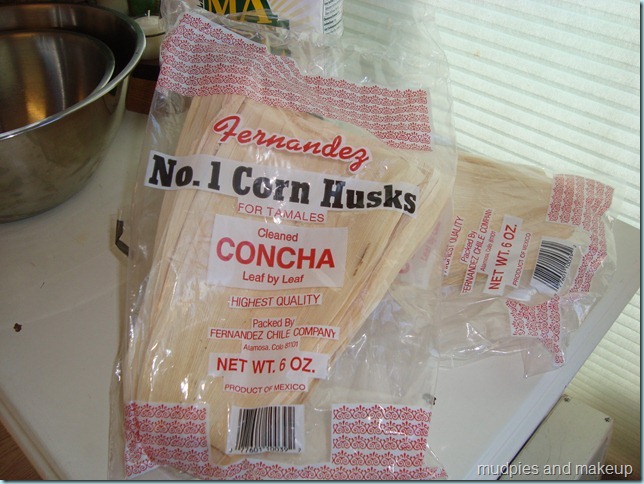
You will need to buy some corn husks. 
I used 2 packages for this round, and had a few left over.
To prepare them, soak them in warm water for 2 hours.
  You can use a clean sink or large bucket,
 just make sure that they are fully immersed into the water. 
You may need to cover them with a heavy bowl to keep them under the water level.

023

Once the above steps are completed,
you are ready to make the masa, or corn flour dough. 
 The brand that we have always used for tamales, is MaSeCa. 
 You can start with the recipe on the back, but as with every thing else in this tutorial,
 you have to go by taste and look. 
 Pour around 2 cups of the MaSeCa into a large bowl. 
 Add the shortening or lard and mix by hand until it is crumbly. 
 Then you will add the reserved broth to stir it into a smooth, paste like consistency. 
Add salt to taste.  I usually warm the broth slightly before adding it. 
 It seems to help melt the shortening and bring out the best flavor of the masa. 

091

The finished masa should have a strong corn flour taste, like a fresh corn tortilla. 
 It should be smooth, and have a mild saltiness to it.
  If you run out of broth, you may substitute chicken broth or warm water. 
This is another step you will need to taste to make sure that it is ready. 
A bland tasting masa will produce a bland tamale.
096

Now you can start to assemble the tamales. 
Having 2-3 people around to help is best. 
Give each person their own job:
 One to dry the corn husks,
another to spread the masa,
and another to spread the meat and chili mixture, and roll the tamale.

Dry each of the corn husks well.
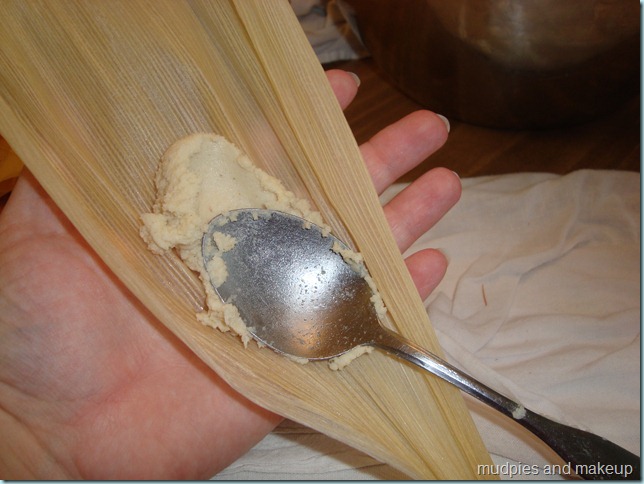
Leaving the bottom 2 inches of the corn husk empty,
spread the masa evenly onto the husk, in a rectangular shape. 
I think this is most easily done by placing the husk in the palm of your hand,
and spreading the masa with a spoon. 
If your masa is not spreading easily,
 it could be that it is too dry and you need to mix some warm broth or water into it. 
 Or it could be that your corn husk has not been dried well. 
It may take you a few times to get the rhythm of it, but stick to it, and it will come.
  Having one person spread the masa will ensure more consistency between the tamales.

094

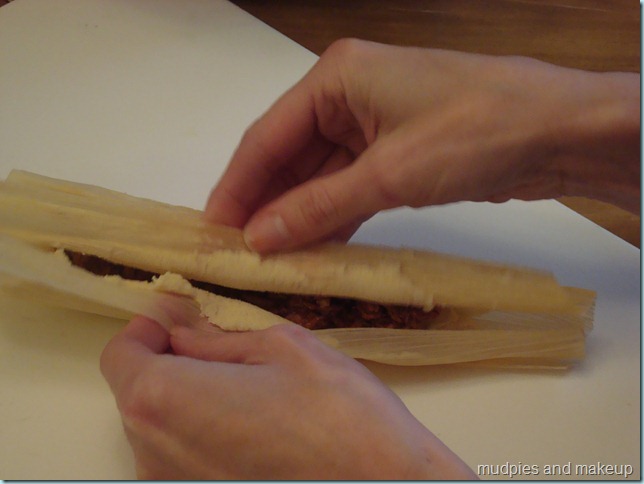
Place a small amount of the meat and chili onto the center of the husk and masa. 
Then roll the husk, one side over the other, and fold up the bottom. 
If you have a husk or two that are too small you can overlap them to make a larger husk if needed.  Likewise, if your husk is too large, you can tear a piece of it off to make it a more manageable size. 
 I would advise against making too large of a tamale,
as it will take a very long time to cook!
095


099

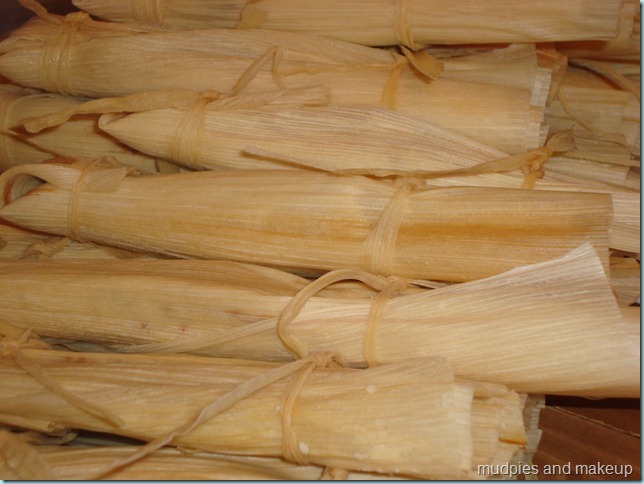
After you have rolled the tamales, you can tie them up with small strips of corn husk. 
My mother-in-law never ties hers, and they always turn out perfectly,
 so this is not a step you have to do. 
It must be my inexperience, but I feel better when I have secured them with ties,
and have less problems with the filling falling out during the cooking process.

102

You will need to stack them into a double boiler, as large of one as you have. 
 Place them folded side down, with the open ends up to the top of the pot. 
They will steam on med-high heat for about 2 hours,
though you can start to check them after 1.5 hours. 
You will occasionally have to add more water to your steaming pot, so that it does not run dry. 
I place a damp towel on top of the tamales and then a lid on top of that
 and it really helps keep the steam in the pot. 

104

To see if the tamales are done cooking,
take one of them from the center of the pot and place it on the counter to cool for 5 minutes. 
Unroll the husk.  If the masa pulls easily away from the husk and is no longer doughy,
 they are ready to eat!  If not, then place it back into the steamer,
 and cook accordingly for 15 minute intervals until they are done.
107

Tamales are absolutely the best when they are fresh from the steamer. 
You can easily reheat them though by re-steaming them for 10-15 minutes,
 or toasting them on a dry camal, or skillet until the husks are slightly blackened. 
 My husband refuses to reheat them in the microwave,
and I agree with him - that method tends to dry them out too much. 
 You can also freeze the tamales in Ziploc bags so you enjoy them year round! 
 Or, if you’re pigs like we are, you can eat them all in one week.

I’d love to hear from you if you made them! 
 Leave me a comment and feel free to ask any questions, I’ll do my best to answer them.